

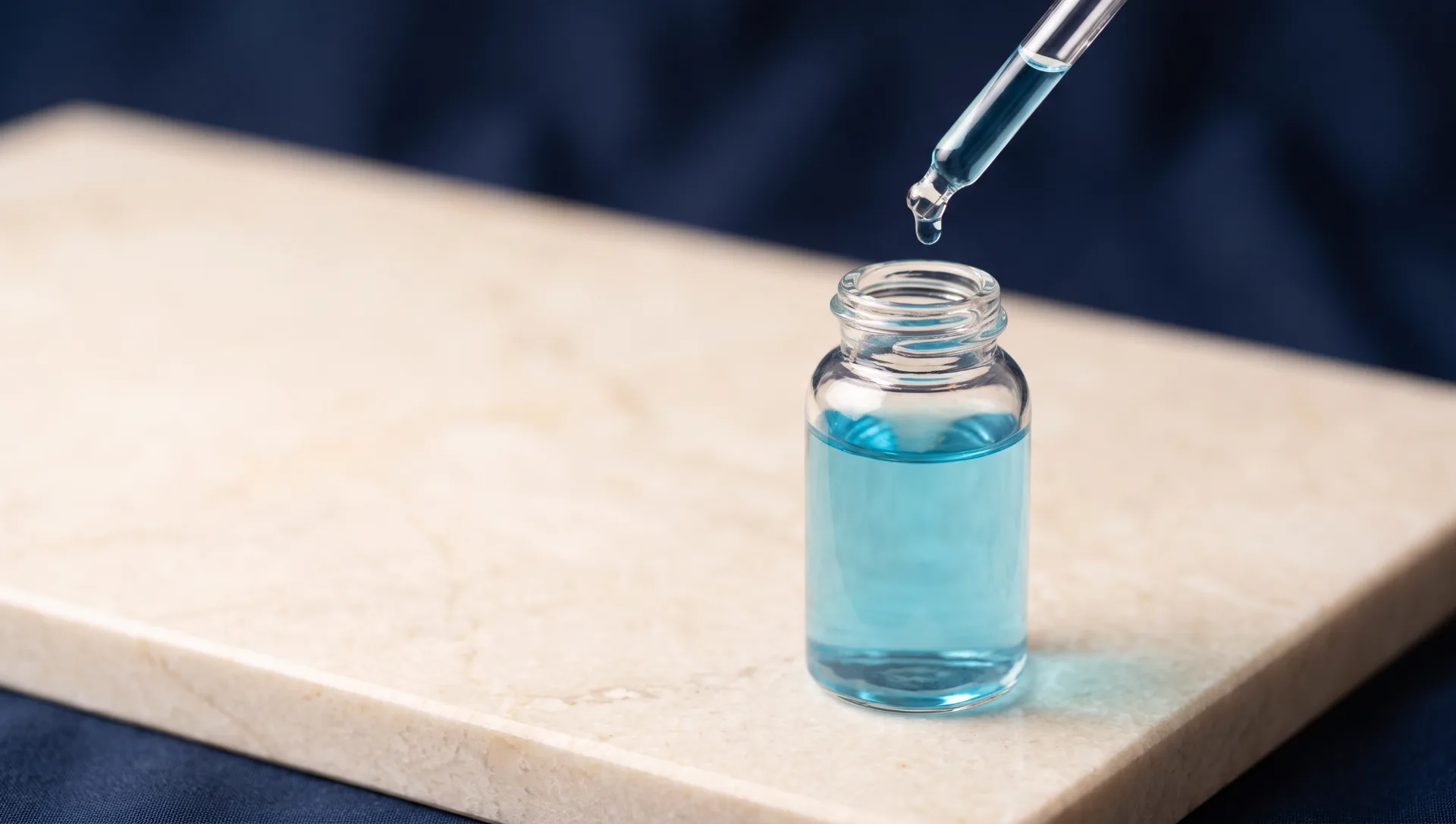
GHK-Cu Copper Peptide in Karachi
A naturally occurring copper peptide with decades of research behind it, used at the clinic for skin quality, collagen support and repair, on its own or combined with microneedling.
Is GHK-Cu right for me?
- For skin that looks tired, thin or slow to recover: fine lines, dullness, early laxity, post-procedure healing, and as a gentler option for sensitive skin.
- Applied topically in a prescribed routine, or delivered deeper with microneedling in a course of clinic sessions.
- Gradual improvement in firmness, texture and glow over a course, with the strongest results when it is part of a wider skin plan.
The peptide your skin already knows.
GHK-Cu is a tripeptide, three amino acids bound to a copper ion, that occurs naturally in human plasma. It was discovered in the 1970s when researchers noticed that something in young plasma made aged liver tissue behave as if it were younger. That something was GHK, and its levels fall steadily with age.
Few cosmetic ingredients have been studied as long. In laboratory and clinical work, GHK-Cu stimulates collagen and elastin production, supports wound healing, calms inflammation and acts as an antioxidant. In skincare studies it improved firmness, fine lines and skin density, which is why it has become one of the most respected peptides in regenerative skin treatment.
At the clinic, GHK-Cu is used where it earns its place: in prescribed topical routines, and delivered into the skin with microneedling for patients who want more than a cream can achieve. Because it is blue, gentle and well tolerated, it also suits sensitive and darker skin types where aggressive treatments risk pigmentation.
What GHK-Cu helps with.
Supports the collagen and elastin that keep skin dense and springy.
→ Dull, tired textureImproves skin quality and glow over a course of use.
→ Healing and recoveryLong studied for wound repair; useful after procedures and for fragile skin.
→ Scalp and hair qualityCopper peptides appear in hair research for follicle support, an option discussed case by case.
→Good candidates
- Skin showing early ageing: fine lines, dullness, thinning, slower recovery
- Sensitive and darker skin types seeking gentle regeneration
- Patients wanting to support results from microneedling, laser or other treatments
Not suitable for
- Known copper allergy or Wilson's disease
- Active infection, open wounds or uncontrolled acne at the treatment area for microneedling delivery
- Pregnancy and breastfeeding, as a standard precaution for in-clinic peptide treatments
- Recent isotretinoin or keloid tendency requires assessment before microneedling
How treatment works at the clinic.
Topical, done properly
As a topical, GHK-Cu is prescribed within a routine that avoids ingredient clashes, since copper peptides should not be layered carelessly with strong acids or vitamin C.
Deeper with microneedling
For deeper delivery, the clinic combines GHK-Cu with microneedling: the channels created by the treatment carry the peptide into the dermis where collagen is actually made. A typical course is three sessions spaced three to four weeks apart, often sequenced with the clinic's other regenerative options such as polynucleotides or exosomes depending on your skin plan.
Your course.
Your skin, history and goals, and where GHK-Cu fits among the clinic's regenerative options.
Topical routine, microneedling sessions, or both, mapped to your skin.
Progress checked over the course; maintenance planned once results land.
GHK-Cu or the other regeneratives?
| What matters | GHK-Cu | Polynucleotides | Exosomes |
|---|---|---|---|
| What it is | Copper tripeptide | Purified DNA fragments | Cell-derived signals |
| How it is given | Topical or microneedled | Injected | After microneedling or laser |
| Best for | Overall skin quality and healing | Under eyes, repair | Recovery and texture |
| Downtime | None to one day | A day or two | A day or two |
Topical GHK-Cu is among the best tolerated actives in skincare; mild temporary redness can occur. With microneedling, expect a day or two of redness as with any needling treatment. Blue staining of skin does not occur at cosmetic concentrations.

"GHK-Cu is one of the quiet achievers of skin science. It will not replace a laser, but as part of a regeneration plan it earns its place."
Consultant Dermatologist and Laser Specialist. Over 35 years of dermatology, trained in Zurich, practising in Clifton since 1999. Page medically reviewed October 2026.
GHK-Cu, answered.
Straight answers from the clinic. If your question is not here, ask on WhatsApp.
Ask on WhatsAppA naturally occurring tripeptide bound to copper, present in human plasma and studied since the 1970s for its role in healing, collagen production and skin regeneration.
In studies it stimulates collagen and elastin, improves firmness and fine lines, supports healing and calms inflammation. Clinically it translates to denser, brighter, better behaved skin over a course.
Topically it has an excellent safety record and suits sensitive skin. The main exclusions are copper allergy and Wilson's disease. In-clinic delivery adds only the usual microneedling considerations.
Yes. It is gentle, non-ablative and does not trigger pigmentation, which makes it a good regenerative option for South Asian skin where harsher treatments need care.
They overlap but differ: polynucleotides are injected and excel under the eyes and for repair, while GHK-Cu works topically and with microneedling across the face. Many plans use both at different stages.
They should be separated rather than layered, usually copper peptides at one time of day and strong acids or vitamin C at another. Your routine is set out properly at consultation.
Texture and glow improve within weeks; firmness and fine lines build over two to three months as collagen remodels. Microneedling courses show compounding results session by session.
The copper complex itself is blue. At cosmetic concentrations it does not stain the skin.
It is used as a cosmetic and regenerative ingredient rather than a licensed drug. That is normal for skincare peptides, and it is one reason professional sourcing and supervision matter.
This page is for education and does not replace medical advice. GHK-Cu is used at the clinic as a cosmetic and regenerative ingredient; it is not a licensed medicine and is not approved by regulators such as the FDA for the treatment of disease. Treatments are provided after an in-person skin assessment. Individual results vary, and no outcome is guaranteed.
Book a skin assessment.
Find out where GHK-Cu fits in your skin plan, and whether topical, microneedled or combined delivery suits you best.
200/1 Clifton 1, Block 5, Clifton, Karachi. Monday to Friday 9:00 to 6:00, Saturday 9:00 to 5:00.
Call or WhatsApp 0301 827 9630