

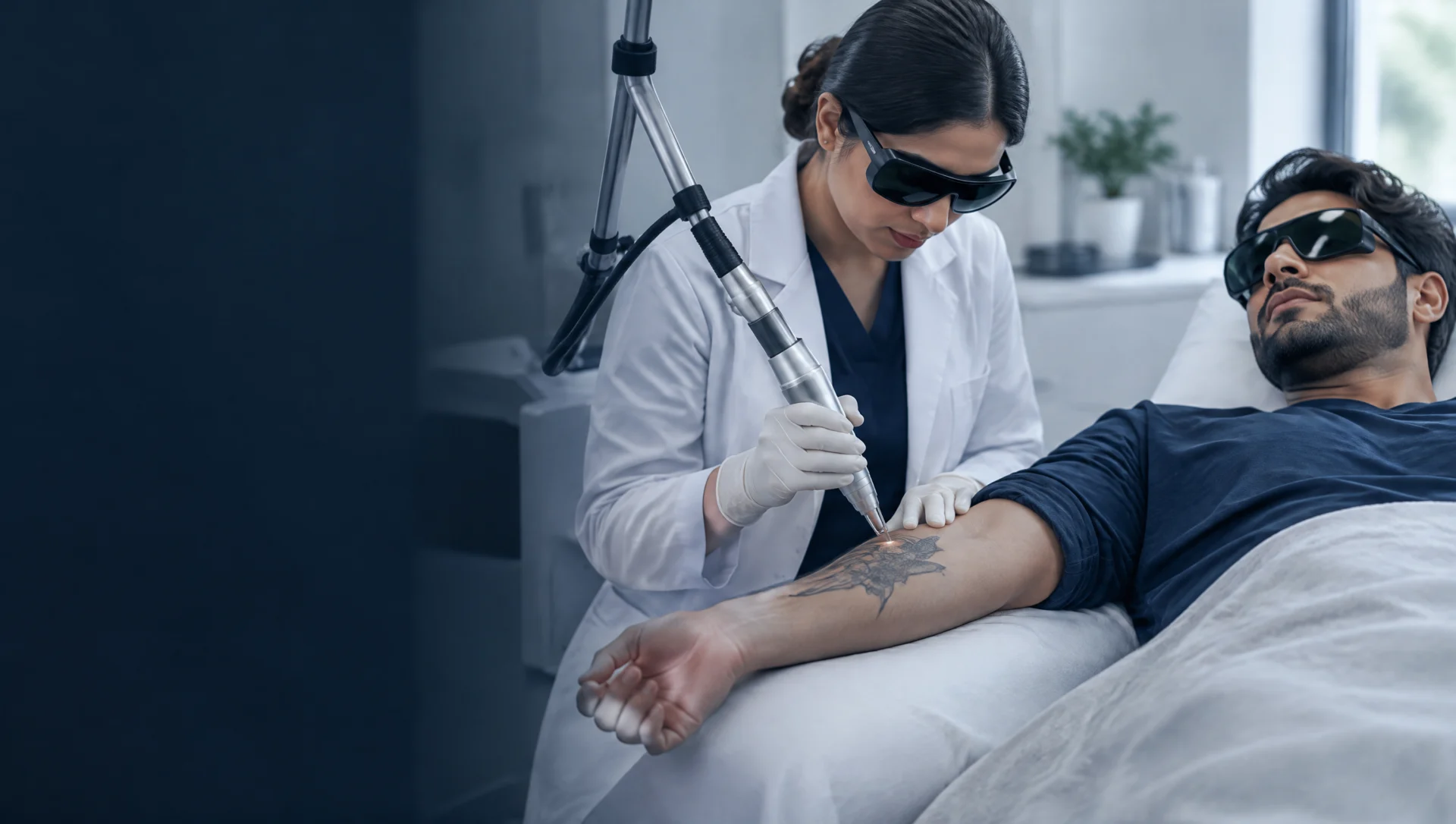
Tattoo Removal in Karachi
Safe, effective removal for all tattoos. Fotona StarWalker MaQX with the FracTAT protocol, clearing more ink per session with less risk to the skin around it.
Is laser tattoo removal right for me?
- For any unwanted tattoo, amateur or professional, black or coloured, on any part of the body.
- Sessions take ten to thirty minutes, six to eight weeks apart; four to six for most amateur tattoos, more for dense colour.
- The skin heals in one to two weeks per session; the ink fades progressively between sessions.
Take it back, safely.
A tattoo is a memory, a fashion or a decision made at twenty. When it no longer fits, laser removal is the safe way to take it back. Q-switched and picosecond-class lasers shatter the ink into particles small enough for the immune system to carry away, with a different wavelength for each colour.
The clinic uses the Fotona StarWalker MaQX, and where appropriate its FracTAT protocol: a fractional pass first creates micro-channels in the skin so gases and ink debris can escape, then MaQX pulses reach deeper pigment. The result is more ink cleared per session, faster fading of coloured pigment and a lower risk of the frosting and blistering older lasers caused.
Black and dark blue ink respond fastest. Most amateur tattoos clear in four to six sessions; dense professional colour work takes longer. Sessions are six to eight weeks apart to let the body clear the ink.
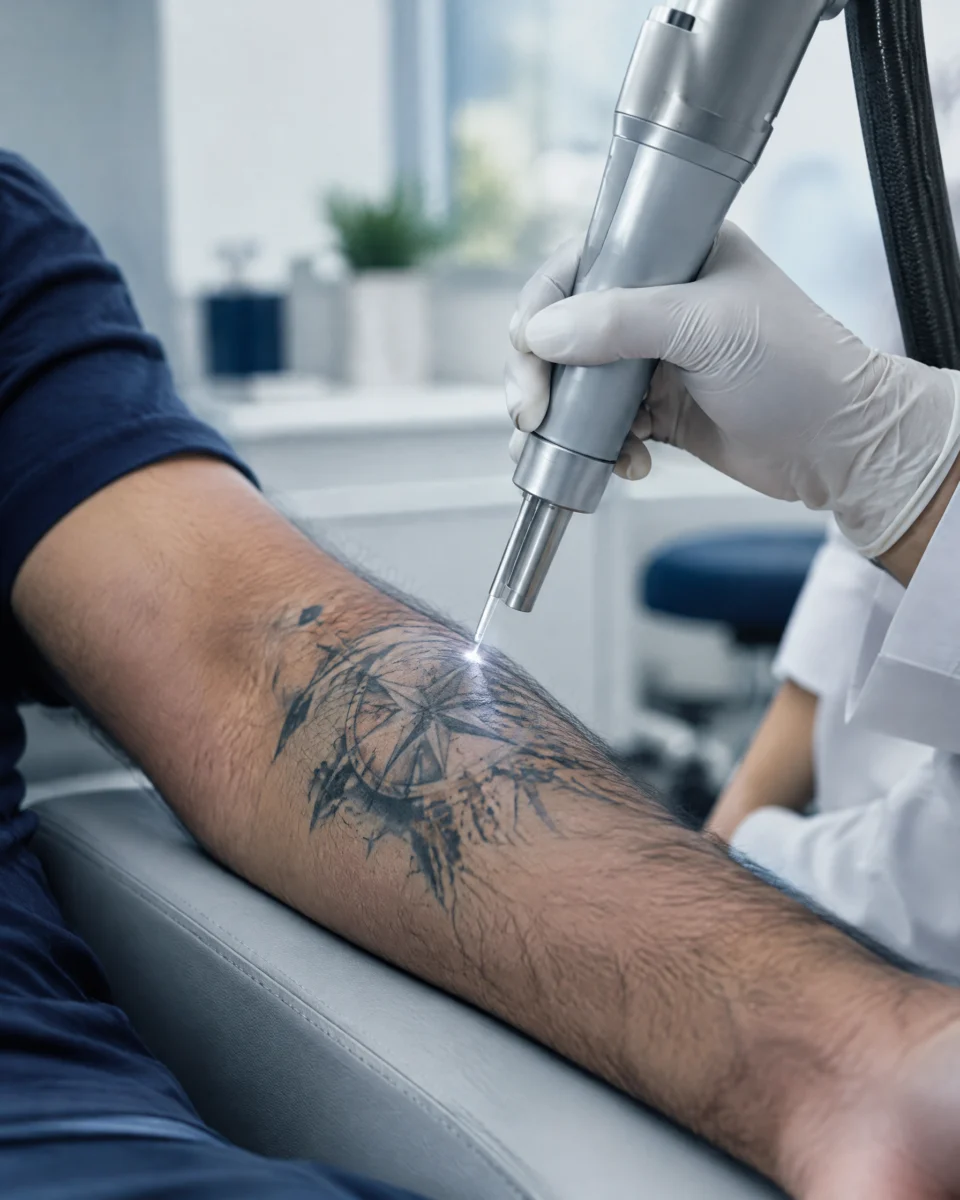
What the laser can clear.
Black and dark ink
The fastest to clear; most amateur black tattoos go in four to six sessions.
Black and dark ink → Concern · unwanted inkColoured tattoos
Red, blue and green each need their own wavelength; the StarWalker carries them all.
Coloured tattoos → Concern · unwanted inkProfessional, dense work
Layered ink takes more sessions; FracTAT speeds the clearing.
Professional, dense work → Concern · unwanted inkCosmetic tattoos
Eyebrow and lip pigment removal, assessed carefully for colour shift.
Cosmetic tattoos → Concern · unwanted inkFading for a cover-up
Lightening a tattoo enough for an artist to work over it.
Fading for a cover-up →Good candidates
- Anyone who wants a tattoo gone or lightened for a cover-up.
- All skin tones; settings are adjusted for darker skin.
- Small and large tattoos alike.
- Patients who want the lowest scarring risk available.
Not suitable for
- Pregnancy.
- Active infection, eczema or a tan on the tattoo.
- Keloid tendency without assessment; the consultation checks.
- Expectations of removal in one session; ink clears progressively.
Assess, shatter, clear.
Assessment and skin type
Dr. Fehmida examines the ink, colours, depth and your skin phototype, and sets the wavelengths and the number of sessions.
FracTAT then MaQX pulses
Where suitable, a fractional pass creates micro-channels, then photoacoustic MaQX pulses shatter the pigment into tiny particles. The tattoo lightens immediately.
The body carries the ink away
Over six to eight weeks the immune system clears the particles. A soothing cream and simple aftercare protect the skin between sessions.
Before and after, by area.
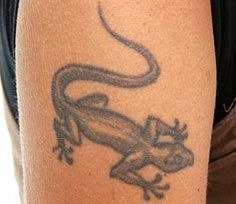
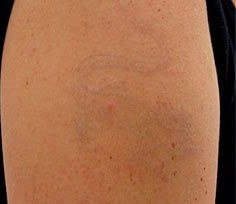
Upper arm
A black tattoo removed with Q-switched Nd:YAG. Courtesy of Uroš Ahčan, M.D., Ph.D.
Clinical photography from Fotona, the maker of the StarWalker MaQX and SP Dynamis lasers used at the clinic, with the treating clinician credited on each set. Individual results vary.
From consultation to results.
Ink, colours and skin type are examined and a session estimate is given honestly.
Ten to thirty minutes with numbing cream. Expect redness, swelling and sometimes small blisters that heal in one to two weeks.
The tattoo is noticeably lighter and the outline softens.
Most tattoos fade to invisible or near-invisible; a faint shadow can remain with some colours.
Laser tattoo removal compared
| Option | Laser tattoo removal | Removal creams and home methods | Surgical excision |
|---|---|---|---|
| How it works | Laser light breaks the ink into tiny particles the body clears | Strips or irritates the top layer of skin | The tattooed skin is cut out and stitched |
| Suits | Most tattoos, most colours, any size | Not recommended | Very small tattoos only |
| Scar risk | Low when the settings match your skin | High | A line scar is certain |
| Sessions | Several, six to eight weeks apart | Repeated, with poor results | One |
For almost everyone, laser is the safest way to remove a tattoo. The consultation sets the number of sessions.

"The measure of a good tattoo laser is what the skin looks like afterwards, not just whether the ink is gone. That is why we use the FracTAT approach."
Consultant Dermatologist and Laser Specialist. Over 35 years of dermatology, trained in Zurich, practising in Clifton since 1999. Page medically reviewed October 2026.
Tattoo removal, answered.
Straight answers from the clinic. If your question is not here, ask on WhatsApp.
Ask on WhatsAppYes. The laser targets the ink and spares the surrounding tissue, which is why the recovery is scar-free in the vast majority of cases. Settings are adjusted for darker skin tones.
Ten to thirty minutes depending on the size of the tattoo, plus numbing time.
The area is red and swollen for a few days and may blister; it heals within one to two weeks. You can work the same day; keep the area covered and out of the sun.
The tattoo lightens immediately and keeps fading for six to eight weeks after each session as the body clears the ink.
Four to six for most amateur black tattoos; six to ten for dense, coloured professional work. The consultation gives you an honest estimate.
It feels like a rubber band snapping on the skin. A numbing cream is applied and sessions are short.
Yes. Black, blue, red and most greens respond well with the right wavelength. Some pastel and fluorescent inks are stubborn, which the assessment will say.
Scarring is rare with modern lasers and the FracTAT approach. Following aftercare and not picking blisters is the main protection.
Yes. Two to three sessions usually lighten a tattoo enough for an artist to work over it.
Pricing depends on the size, colours and number of sessions. The clinic shares the exact fee at the consultation. Ask on WhatsApp for current pricing.
Yes, with the right settings. Brown skin has more melanin, so Dr. Fehmida uses wavelengths and energy levels that target the ink while protecting your natural pigment, and spaces sessions further apart. A test patch on the first visit shows how your skin responds.
Keep it clean and dry, apply the healing ointment we give you, and cover it for the first day or two. Do not pick at blisters or scabs. Keep it out of the sun and use sunscreen once it has healed, because tanned skin cannot be treated safely.
Often, yes. Some cosmetic inks contain white or skin-toned pigments that can darken when the laser first hits them, so Dr. Fehmida always tests a small spot first and then plans the sessions around how that spot responds.
Start with an assessment.
A short consultation examines the ink and gives you an honest session estimate. Send a photo on WhatsApp for a first opinion, or leave your number.
200/1 Clifton 1, Block 5, Clifton, Karachi. Monday to Friday 9:00 to 6:00, Saturday 9:00 to 5:00.
Call or WhatsApp 0301 827 9630