

Hair Fall and Hair Loss treatment in Karachi
Hair fall and thinning in men and women, diagnosed by a consultant dermatologist first, then treated with the right mix of prescription care, mesotherapy, PRP, exosomes and transplant support.
Why hair falls
- Losing 50 to 100 hairs a day is normal. Clumps on the pillow, a widening parting or a thinner ponytail are not.
- Sudden hair fall usually follows illness, fever, stress, childbirth, crash dieting, or low iron, thyroid or vitamin D, and often recovers once the trigger is fixed.
- Gradual thinning at the crown, hairline or parting is usually pattern hair loss, which is genetic and hormonal and keeps progressing without treatment.
Understand the cause first.
Hair loss has causes, and the treatment only works when the cause is right. Pattern loss is hormonal and genetic; diffuse shedding follows illness, stress, childbirth or deficiency; scalp conditions and traction cause their own patterns. The clinic diagnoses first, with examination and blood tests where needed, then builds the plan.
The ladder runs from scalp health and mesotherapy, through PRP and the MCT Plasma protocol, to peptide hair fillers, exosomes, Rigenera micrografts and the MCT stem cell protocol, alongside prescription treatment and support for transplant patients.
Not sure whether to see a trichologist or a dermatologist first? Read trichologist or dermatologist for hair loss in Karachi.
The treatments that work for it.
Hair restoration consultation
Examination and tests where needed.
Hair restoration consultation → FoundationHydraFacial for scalp and mesotherapy
Scalp health and nourishment.
HydraFacial for scalp and mesotherapy → PlateletsPRP and MCT Plasma
Your own growth factors, standard or advanced.
PRP and MCT Plasma → PeptidesCYJ hair filler
For more advanced thinning.
CYJ hair filler → RegenerativeExosomes, Rigenera and MCT Stem Cells
The strongest signals for resistant thinning.
Exosomes, Rigenera and MCT Stem Cells → PrescriptionMedical treatment
Where the cause needs it.
Medical treatment →Good candidates
- Thinning or a widening parting.
- Increased shedding.
- A receding hairline or thinning crown.
- Transplant patients wanting better results.
Not suitable for
- Completely bald areas without follicles, which need a transplant.
- Active scalp infection.
- Pregnancy for injectables.
- Blood disorders for platelet treatments.
How the clinic approaches it.
Diagnosis
Cause identified before any treatment.
The ladder
The right rung for the degree of loss, combined where useful.
Maintenance
Sessions every four to six months hold the result.
From consultation to results.
Diagnosis and plan.
Sessions by tool.
Shedding down, density up.
Every four to six months.
Hair loss treatments compared
| Treatment | Best for | How it is given | When results show |
|---|---|---|---|
| Prescription treatment | Most pattern hair loss and many cases of hair fall | Tablets, lotions or foams chosen by the doctor | Three to six months, used long term |
| Mesotherapy | Early thinning and a shedding, undernourished scalp | Fine injections of nutrients into the scalp | After a course of sessions |
| PRP and MCT Plasma | Active hair fall and early to moderate thinning | Your own platelets injected into the scalp | Shedding slows in weeks, density from three months |
| Exosomes | Thinning that has not responded enough to PRP | Regenerative signals delivered into the scalp | Three to six months |
| Hair transplant | Bald areas where the follicles are gone | Surgery by a transplant surgeon, with PRP support from the clinic | Nine to twelve months |
Most patients do best with two or more of these together. The consultation decides the mix and the order.

"Hair loss patients arrive having tried products for years. What they needed first was a diagnosis."
Consultant Dermatologist and Laser Specialist. Over 35 years of dermatology, trained in Zurich, practising in Clifton since 1999. Page medically reviewed October 2026.
Hair fall and hair loss, answered.
Straight answers from the clinic. If your question is not here, ask on WhatsApp.
Ask on WhatsAppHair fall is shedding: more hairs than usual come out, often after a trigger such as illness, stress or childbirth, and it usually settles once the trigger is treated. Hair loss means the hair is not growing back as it should, as in pattern hair loss, where the follicles slowly shrink. Many people have both, which is why diagnosis comes first.
Losing around 50 to 100 hairs a day is normal, and you may notice more on wash days. If you are losing clumps, can see more of your scalp, or your ponytail has become thinner, it is worth a consultation.
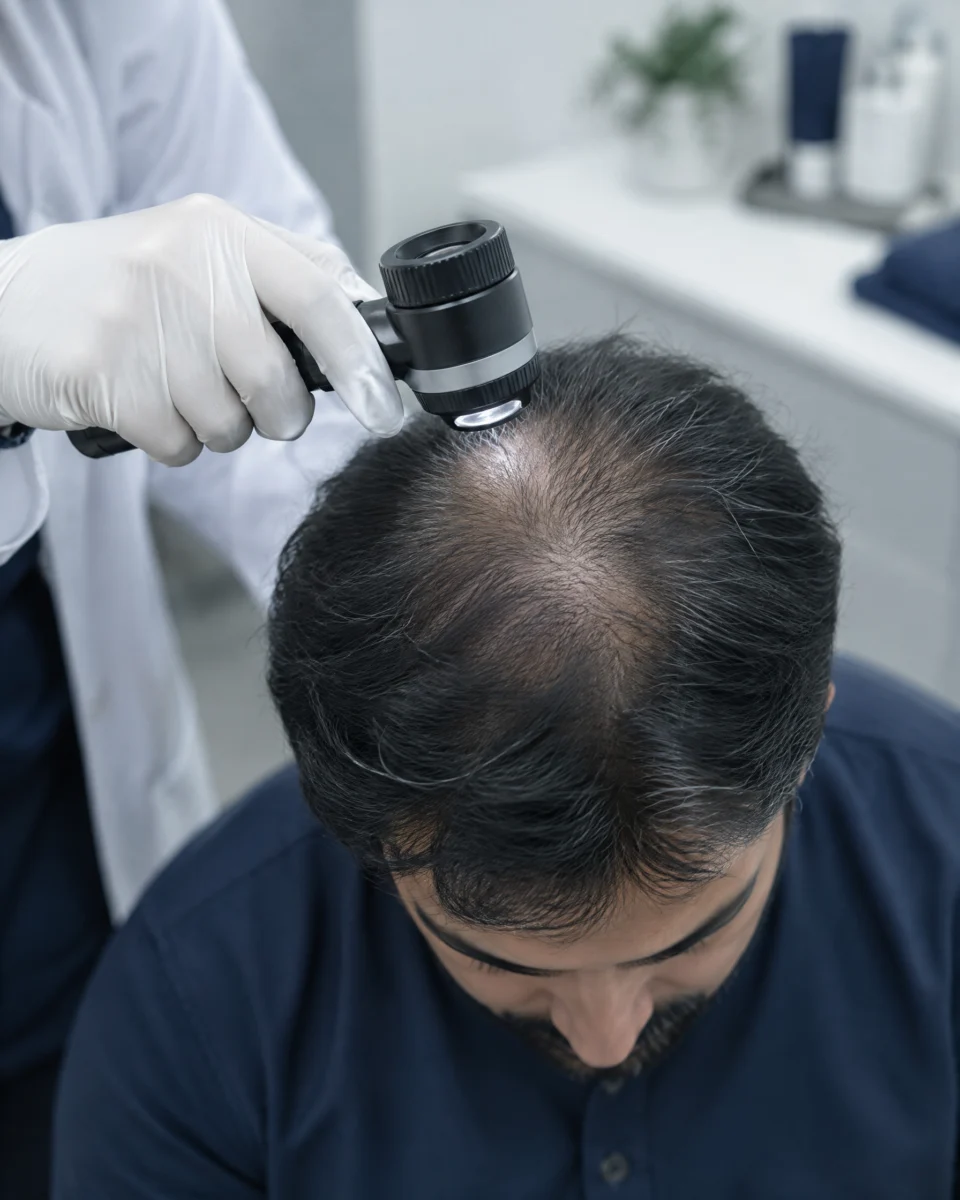
Dr. Fehmida examines the scalp and hair first, often with a dermatoscope. Depending on what she finds, blood tests may include a blood count, ferritin for iron stores, thyroid function, vitamin D and B12, and hormone tests for women with irregular periods, acne or excess facial hair.
Thinning can often be reversed while the follicles are still alive, and treatment works best when it starts early. Areas that have been bald for a long time have lost their follicles and need a transplant.
It depends on the cause and how far the loss has gone. Shedding from low iron needs the iron corrected, not injections. Pattern hair loss usually needs prescription treatment, often combined with PRP. The consultation finds the cause and then decides.
PRP works best for active hair fall and early to moderate thinning. A typical course is three to four sessions about a month apart, then a maintenance session every four to six months. It does not regrow hair in bald areas where the follicles are gone.
The scalp is numbed first, so most patients feel pressure and mild stinging rather than pain. The scalp can feel tender for a day, and you can go back to work straight after.
Yes. Hair loss in women is common, often shows as a widening parting, and responds well once the cause is found. Low iron, thyroid problems, PCOS and the months after childbirth are frequent triggers, and some prescription options differ for women, so the plan is made for you.
Yes. Higher androgen levels in PCOS can thin the hair on the scalp while increasing hair on the face and body. Treating the hormones alongside the scalp gives the best result, and Dr. Fehmida often works with your gynaecologist on this.
Usually, yes. Heavy shedding often starts two to four months after delivery and settles within six to twelve months. If it lasts longer, or the hair does not thicken again, there may be low iron, a thyroid change or underlying pattern loss that needs treatment.
Oils and shampoos do not cause or cure hair loss on their own, although heavy oiling can make dandruff worse. Hard water can leave hair dry and brittle so it breaks, but breakage is not the same as hair falling from the root. Shedding from the root usually has a cause inside the body.
Shedding usually slows within six to eight weeks. New growth and density take three to six months because hair grows slowly, so we compare photos at each review.
It depends on the cause and the plan, which is set at the consultation. Ask on WhatsApp for current pricing.
Start with a consultation.
A twenty-minute consultation with Dr. Fehmida decides whether this is the right treatment for your hair, or whether something gentler or stronger would serve you better. Message on WhatsApp or leave your number and the clinic calls you back.
200/1 Clifton 1, Block 5, Clifton, Karachi. Monday to Friday 9:00 to 6:00, Saturday 9:00 to 5:00.
Call or WhatsApp 0301 827 9630